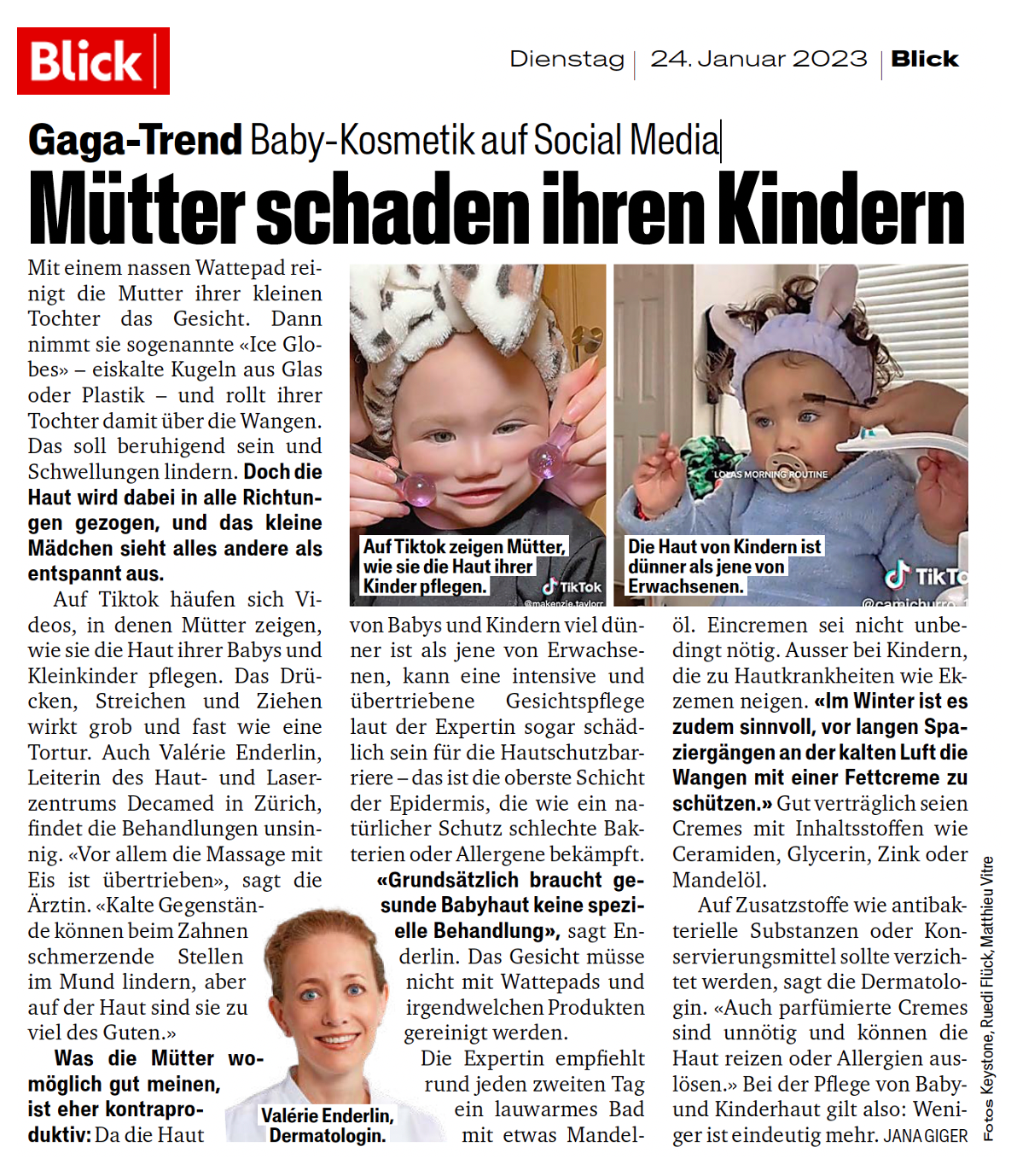
Dr Enderlin answers the questions of theNewspaper Blick , published on Tuesday, 24 January 2023
Facial care for toddlers? Yes, it really exists They press, stroke, and knead – mothers present on TikTok how they want to improve their babies' skin. This can be damaging, says Valérie Enderlin. The dermatologist knows which products are truly necessary for baby skin.
Ice for swollen cheeks? The little girl seems very skeptical.
The mother cleanses her little daughter's face with a wet cotton pad. Then she takes so-called "ice globes" – ice-cold balls made of glass or plastic – and rolls them from the corners of her mouth over her cheeks to her ears. This is supposed to soothe and reduce swelling. But the skin is pulled in all directions, and the little girl looks anything but relaxed.
TikTok is brimming with videos in which mothers demonstrate step-by-step how to care for their babies' and toddlers' skin. The pressing, stroking, and pulling seem harsh and almost like torture. Valérie Enderlin, director of the Decamed skin and laser center in Zurich, also finds the treatments pointless. "Ice massage, in particular, is excessive," says the doctor. "Cold objects can soothe sore spots in the mouth during teething, but on the skin, they're too much of a good thing."
What the mothers may mean well is actually counterproductive: Since the skin of babies and children is much thinner than that of adults, intensive and excessive facial care can, according to the expert, even be harmful to the skin's protective barrier - this is the top layer of the epidermis, which acts as a natural protection against bad bacteria or allergens.
"Basically, healthy baby skin doesn't need any special treatment," says Enderlin. The face doesn't need to be cleaned with cotton pads or any other products.
The expert recommends a lukewarm bath with a little almond oil about every other day. Moisturizing isn't absolutely necessary, except for children who are prone to skin conditions like eczema. "In winter, it's also a good idea to protect your cheeks with a moisturizer before long walks in the cold air." She says creams with ingredients like ceramides, glycerin, zinc, or almond oil are well-tolerated.
Certain additives such as antibacterial substances or certain preservatives should be avoided, says the dermatologist. "Perfumed creams are also unnecessary and can irritate the skin or even trigger allergies." When it comes to caring for baby and children's skin, less is definitely more.
Collagen for the skin: What really works | DECALYS
Drink, mask or cream: Dr. Enderlin explains which form of collagen reaches the skin and what you can omit. Dermatologically sound from Zurich.
When searching for a scar gel after surgery or injury, you’ll find hundreds of products—but very few clear answers. This article explains what defines a high-quality scar treatment, which active ingredients actually work, and which product is right for your specific scar type.
Which scar gel do dermatologists recommend?
Silicone is considered one of the most effective care standards for fresh and slightly raised scars. Therefore, dermatologists recommend silicone-based products as the first choice for most scar types – either as a gel or as a patch. Silicone protects the scar through occlusion (moisture retention) and regulates collagen production. Treatment should begin as early as possible after wound closure and be carried out consistently for at least 8–12 weeks.
How does silicone work on scars?
Silicone does not act "chemically", its function is primarily physically:
Creates a protective film on the skin
Locks in moisture → creating an optimal healing environment for the scar
Reduces tension in the skin
Regulates collagen formation, so that less excess scar tissue is formed
Result: Scars become flatter, softer and less visible. It is important to know that silicone works best on fresh scars after the wound has closed.
Quick Facts:
Gold standard: Medical silicone has been the most cited active ingredient in dermatological scar care for over 30 years.
Timing: Start no earlier than 10–14 days after the injury – as soon as the wound is completely closed.
Patience pays off: First visible improvements appear after 8–12 weeks; full results after 3–6 months.
Table of Contents
How does a scar form – and why does it need targeted care?
Comparison of the most important active ingredients in scar care
Gel, patch or ointment – which format is suitable for which situation?
When to start scar care – and for how long?
What really helps – and what doesn't: Common mistakes in scar care
Conclusion & FAQs
How does a scar form – and why does it need targeted care?
A scar is not a defect of the body – it is the result of a precise healing process. After every deeper skin injury, the body goes through three phases:
Phase 1 – Inflammation (Days 1–3): The body cleans the wound, blood vessels are sealed, immune cells fight germs.
Phase 2 – Proliferation (Days 4–21): New cells are formed, collagen fibers lay over the wound – initially disordered and dense. The scar is still red and raised at this stage.
Phase 3 – Remodeling (up to 2 years): The collagen tissue is slowly rebuilt. This is where it is decided how inconspicuous a scar will be – and this is exactly where targeted scar care comes into play.
Without care, there is a risk that the collagen will be distributed irregularly or even excessively formed: The scar remains raised, hard, or discolored. With the right care, this process can be actively supported.
Comparison of the most important active ingredients in scar care
Active Ingredient
Mechanism of Action
Suitable for
Decalys Product
Medical Silicone
Occlusion: Traps moisture, regulates collagen production, flattens scar
Hypertrophic scars, keloids, surgical scars, C-section
LE GEL,
CICAFILM
Alpha-3 Complex®
Supports cellular autophagy (cell cleansing), promotes active skin regeneration
All scar types, especially sensitive and irritated skin
LE BAUME,
LA POMMADE
Panthenol (B5)
Moisture-binding, anti-inflammatory, promotes cell regeneration
Fresh, irritated scars, red areas
LE BAUME
Zinc
Antibacterial, wound-healing, anti-inflammatory
Fresh scars, areas at risk of infection
LE BAUME
Vitamin C
Regulates collagen synthesis, has antioxidant effect and reduces pigmentation
Older, discolored or pigmented scars
LE GEL
Onion Extract
Inhibits excessive collagen formation
Hypertrophic scars (standard active ingredient)
—
What distinguishes medical silicone from drugstore scar gels?
The crucial difference lies in concentration and purity. Medical silicone in products like CICAFILM or LE GEL forms a uniform, breathable film that protects the scar for many hours. Drugstore products often contain lower concentrations or fragrances that can irritate sensitive scar skin.
Gel, patch or ointment – which format is suitable for which situation?
Format
Properties
Ideal for
Silicone Gel (LE GEL)
Transparent, fast-drying, discreet
Face, neck, eyelid lift, small scars
Silicone Patch (CICAFILM)
24h protection, waterproof, suitable for sports
Surgical scars, C-sections, back, large areas
Care Balm (LE BAUME)
Soothing, many active ingredients
Reddened, irritated skin, e.g. after laser/peeling
Regenerative Ointment (LA POMMADE)
Intensively nourishing, ideal for massages
Older, hardened scars, stretch marks
Expert tip on mechanics: While CICAFILM, with its patch structure, additionally protects the scar from mechanical stretching or friction from clothes (especially valuable on joints or the abdominal wall), LA POMMADE enables the pressure massage so important for healing. Through targeted pressure, adhesions in the tissue are mechanically released, which makes the scar softer and more pliable.
When to start – and for how long?
Day 0–7: Wound care only, no scar care product.
Day 7–14 (wound closed, after suture removal): Start with silicone product: LE GEL on the face, CICAFILM on the body
Week 3–12: First visible improvements.
Month 6–24: For older scars, use LA POMMADE + massage.
For red, irritated or abraded skin, we recommend using LE BAUME. This is a nourishing balm that soothes the skin and supports skin regeneration. Apply at least twice a day for 1 week.
What really helps – and what doesn't: Common mistakes
Vitamin E oil: Can make the skin softer and more elastic, but has no proven effect on the visible appearance of scars
Sun without protection: The skin of the scar is extremely UV-sensitive. Without SPF 50 or covering, permanent dark pigmentation is a risk.
Premature termination of therapy: The minimum application period is 8–12 weeks.
Application to open wounds: Only start after complete wound closure!
Conclusion
Scar care is a combination of active ingredient, format, and timing. Medical silicone is the gold standard, while Decalys' Alpha-3 Complex® complements this approach through active cell regeneration (autophagy).
→ Start the Decalys scar test now