

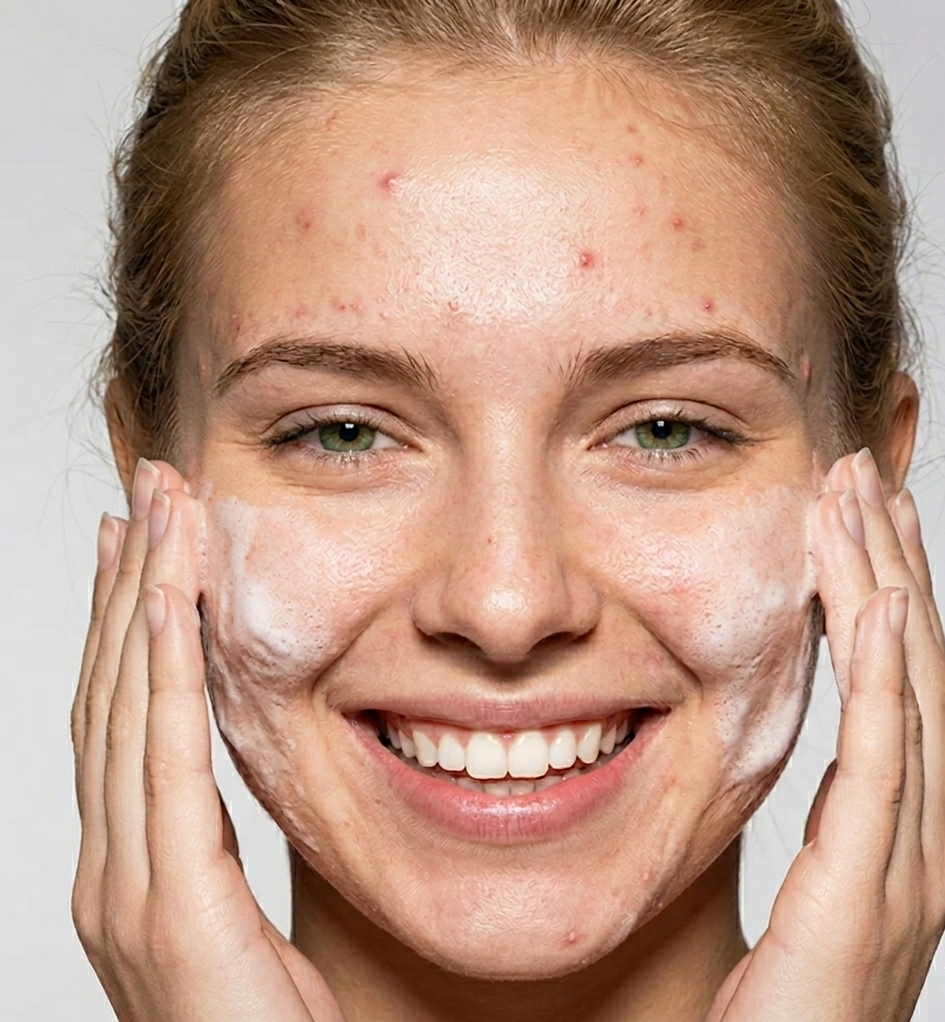
The Power of BHA: How Salicylic Acid Clears Congested Pores
The summary: Salicylic acid is a fat-soluble beta-hydroxy acid that penetrates deeper into the pores than traditional fruit acids. It belongs to the so-called beta-hydroxy acids, also known as BHA. Salicylic acid is the best-known and most commonly used BHA in skincare. Often, "BHA" is even used simply as a synonym for salicylic acid. Salicylic acid dissolves the biological "glue" between dead skin cells, frees pores from sebum plugs, and simultaneously has an anti-inflammatory effect. Initial improvements are seen after 2 weeks, and an even skin tone after 4–6 weeks.
Quick Facts:
- Mechanism of action: Fat-soluble, penetrates directly into the pores, works not only on the surface.
- Anti-inflammatory: Chemically related to Aspirin®, not only exfoliates but actively soothes redness.
- Realistic Timeline: Visible results expected after 4–6 weeks, not overnight.
Table of Contents
- What is Salicylic Acid (BHA) and how does it differ from AHA?
- How does BHA work in the pore? The 3-step mechanism
- Realistic Expectations: What happens when?
- Decalys Gel Pureté: Why three active ingredients instead of just one?
- Wash-off vs. Leave-on: Why the formula is crucial
- Dr. Enderlin's Routine Rules for BHA
- Who is Salicylic Acid suitable for and who is it not?
- Conclusion
- FAQs
What is Salicylic Acid (BHA) and how does it differ from AHA?
Salicylic acid belongs to the group of beta-hydroxy acids (BHA). Originally derived from willow bark, a high-purity, synthetic form is used today, with identical effects but consistent quality.
The crucial difference to AHA acids like glycolic acid: BHAs are fat-soluble. AHAs are water-soluble and work on the skin's surface. BHAs penetrate through the sebum directly into the pores. This makes them the right choice for clogged pores, blackheads, and oily skin.
BHA vs. AHA: What's right for you
|
Criterion |
AHA (e.g. Glycolic Acid) |
BHA (Salicylic Acid) |
|
Solubility |
Water-soluble |
Fat-soluble |
|
Depth of Action |
Skin surface |
Deep in the pore |
|
Main problem |
Dull complexion, fine lines, pigmentation spots |
Blackheads, blemishes, oily skin |
|
Anti-inflammatory |
No |
Yes |
|
Suitable for |
Dry to normal skin |
Oily skin, combination skin, acne |
|
Combination possible |
With BHA in wash-off products |
With AHA in wash-off products |
How does BHA work in the pore? The 3-step mechanism
Dr. Enderlin explains the process without jargon, in three concrete steps.
Step 1: Dissolve the "glue"
The outermost layer of skin consists of dead cells held together by so-called cell adhesions, a type of biological glue. Salicylic acid loosens these connections. The old cells gently detach on their own, without mechanical rubbing.
Step 2: Free pores from within
Due to its fat-solubility, BHA penetrates deep into the sebum channel and dissolves plugs of sebum and skin flakes. The result: pores appear visually finer - not because they shrink (pores cannot do that), but because the content that makes them visible is removed.
Step 3: Soothe inflammation
Chemically, salicylic acid is related to Aspirin® (acetylsalicylic acid). Therefore, it not only exfoliates but also has anti-inflammatory properties, so redness and active pimples heal faster.
Realistic expectations: What happens when?
The most common mistake with BHA: giving up too early. Skincare should follow the skin renewal cycle, which is about 28 days in adults.
|
Period |
What you can observe |
|
First application |
Skin feels smoother, excess shine is reduced |
|
Week 1–2 |
Fewer new blackheads; possible purging (see below) |
|
Week 4–6 |
Finer skin texture, visually smaller pores, faster healing |
|
From week 8 |
Stable, even skin, fewer impurities in the long term |
What is purging and is it normal?
Purging refers to a temporary initial worsening: impurities that are already lurking beneath the surface come to light more quickly. This is not a sign that the product is unsuitable, it shows that it is working. Purging should not last longer than 4–6 weeks. If it persists longer, it is advisable to consult a dermatologist.
Decalys Gel Pureté: Why three active ingredients instead of one?
Gel Pureté combines three active ingredients with different points of action:
Salicylic acid (BHA) - Deep pore cleansing
Normalizes sebum production and cleanses pores from within. This is the core active ingredient against blackheads and impurities.
Glycolic acid (AHA) – Surface renewal
Dissolves dead skin cells on the surface and promotes cell renewal of the epidermis. This ensures a more even, radiant complexion.
Azelaic acid ester, skin tone and texture balancing
Gel Pureté does not contain pure azelaic acid, but a mixture of azelaic acid esters. These even out skin tone, improve texture and support post-inflammatory discolorations (acne marks). They are milder than pure azelaic acid and better tolerated for daily use.
Why this combination works
|
Active ingredient |
Point of attack |
Main benefit |
|
Salicylic acid (BHA) |
Deep in the pore |
Blackheads, sebum regulation |
|
Glycolic acid (AHA) |
Skin surface |
Cell renewal, radiance |
|
Azelaic acid ester |
Skin tone & texture |
Acne marks, discolorations |
|
Antioxidants |
Protective layer |
Free radicals, environmental protection |
Wash-off vs. Leave-on: Why the formula is crucial
Most BHA products on the market (such as Paula's Choice Skin Perfecting BHA Liquid, The Ordinary Salicylic Acid 2% Solution, etc.) are leave-on products: They remain on the skin all day or all night.
This has advantages (longer exposure time), but also a disadvantage: The potential for irritation is significantly higher, especially when several active ingredients are combined. Glycolic acid and salicylic acid as a leave-on at the same time? Most dermatologists would not recommend this for sensitive skin.
Gel Pureté is designed as a wash-off product. The exposure time is shorter, which allows for the triple combination of AHA, BHA, and azelaic acid esters that a leave-on product could not achieve without stressing the skin barrier. You get the full effect of the acids with significantly reduced irritation potential.
Dr. Enderlin's Routine Rules for BHA
Rule 1: Slow & Steady - Start 2–3 times a week
The skin needs to get used to the increased cell renewal. Those who start daily risk redness and dryness, not because the product is wrong, but because the skin needs time. After 2–3 weeks, the frequency can be gradually increased.
Rule 2: No layering with retinol on the same evening
Retinol is an effective cell regenerator, but in combination with BHA on the same evening, it can lead to over-irritation, dryness, and redness. The recommendation: alternate evenings. Evening 1: Gel Pureté. Evening 2: Retinol product. This way, the skin benefits from both active ingredients without being overwhelmed.
Rule 3: Sun protection is not optional
BHA removes dead cells, revealing fresh, sensitive skin underneath. This reacts more strongly to UV radiation. Daily sun protection (preferably SPF 50) is therefore not an add-on, but mandatory. Dr. Enderlin recommends DECALYS multi-défense Lotion as the last step in the morning routine. In addition to highly effective UVA and UVB protection (SPF50), it also contains a blue light filter.
Who is salicylic acid suitable for and who is it not?
Well suited
Oily skin, combination skin, skin prone to blackheads and acne. Those suffering from clogged pores, a shiny T-zone, or frequent blemishes will benefit most from BHA.
With caution
Very dry or extremely sensitive skin: Salicylic acid can have a drying effect. Those prone to dryness should initially apply Gel Pureté only to affected areas (T-zone, chin) and not over the entire face.
Do not combine
Directly after laser treatments, peels, or other skin procedures where the skin barrier is weakened, BHA should be paused until the skin has fully recovered.
Conclusion
Salicylic acid works, but it's not an instant fix. Those who start with realistic expectations, gradually introduce it, and consistently stick to the routine will see real results after 4–6 weeks: a more refined complexion, fewer blackheads, and a more even skin tone.
The decisive advantage of Decalys Gel Pureté lies not in a single active ingredient, but in the triple combination of BHA, AHA, and azelaic acid esters, made possible by the wash-off format, which minimizes the risk of irritation without sacrificing effectiveness.
For skin that truly needs to clear up, this is not a sprint. It's a comprehensive skincare concept.
Do you want to know if Gel Pureté is the right choice for your skin type?
Discover Dr. Enderlin's complete routine, developed for oily, impure, and demanding skin.


