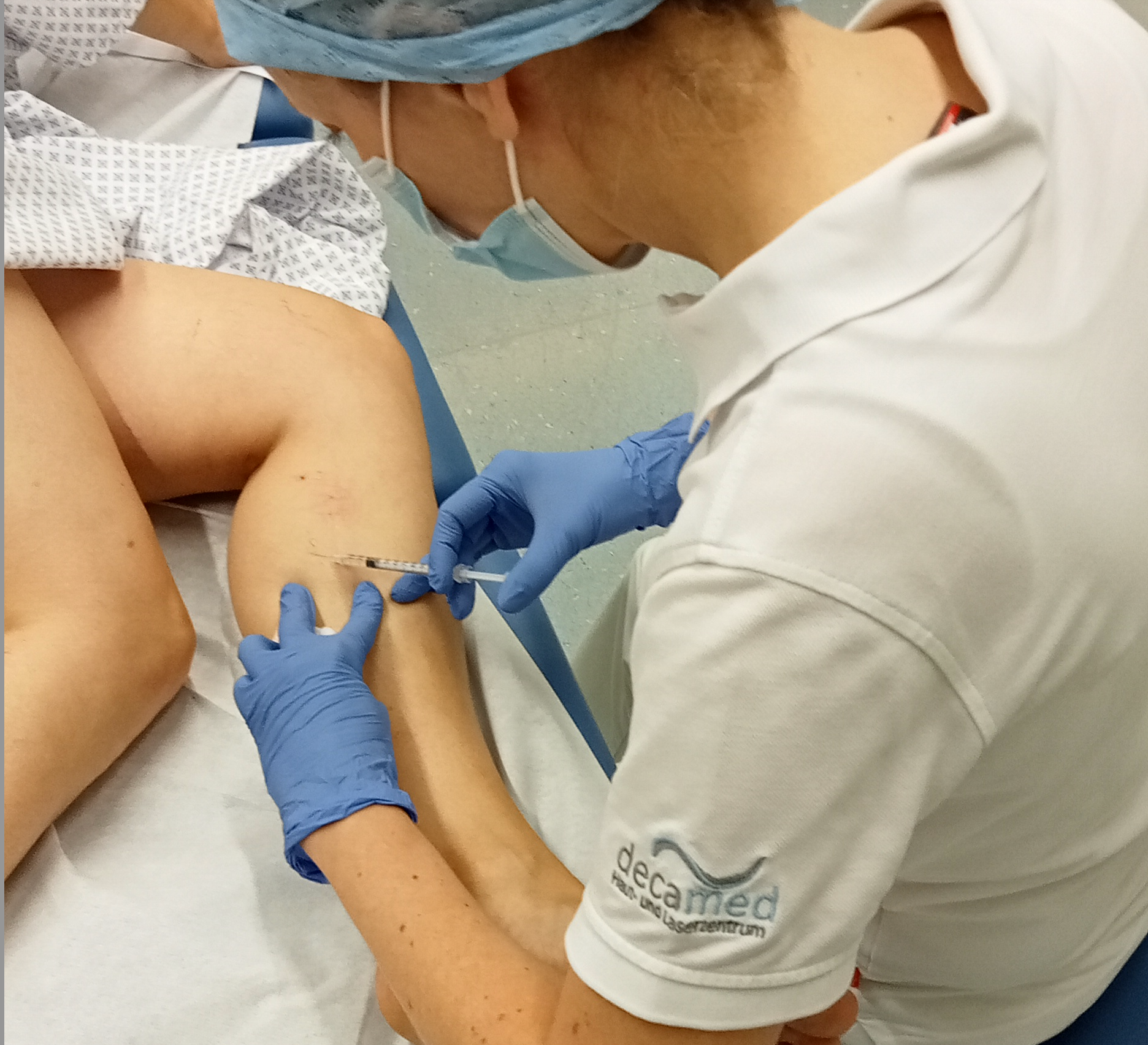
Spider veins can be a nuisance, but with the right treatment, you can bid them farewell. Dr Enderlin is here to guide you through sclerotherapy, a non-invasive procedure offered at DECAMED that effectively deals with these unwanted veins.
What is sclerotherapy (sclerosing treatment)?
Sclerotherapy involves the obliteration of veins, ranging from tiny spider veins to larger ones. Dr Enderlin uses the approved sclerosing agent aethoxysklerol* to induce a controlled inflammation in the veins. This process leads to the veins sticking together and eventually fading or becoming invisible. Patients typically undergo 2 to 4 treatments, each at least a month apart, for significant improvement. Wearing a compression stocking after treatment aids the adhesion process.
* approved in Switzerland
The treatment process
Sclerotherapy is a virtually pain-free outpatient procedure carried out in theDECAMEDSkin and Laser Center's operating theater. The areas to be treated are disinfected and the sclerotherapy product is injected using a fine needle in a highly targeted manner. The procedure is short and lasts approximately 30 minutes to one hour.
Sclerotherapy vs. other methods
Sclerotherapy stands out as a highly effective, cost-efficient, and minimally invasive option compared to laser treatments. It's the preferred method for treating spider veins at DECAMED .
Risks and complications
Sclerotherapy is a low-risk procedure, but like any medical intervention, side effects may occur in very rare cases. Sensitive skin types and those exposed to the sun too early may develop brown streaks on the skin. These correspond to pigment deposits and fade over time. Consistent wearing of compression stockings and avoiding the sun in the first 6 weeks can help prevent this side effect.
Post-treatment care
After sclerotherapy, patients may experience temporary discoloration, itching, and minor bleeding. Compression stockings are recommended for the first 24 hours and continued throughout the day for a week. Vigorous sports and hot baths (sauna…) should be avoided for the next 2-3 weeks. Patients should also refrain from sunbathing for 6-8 weeks to prevent hyperpigmentation.
Results and expectations
Patients often see significant improvements after just one treatment, although multiple sessions may be necessary for optimal results. Dr Enderlin recommends sclerotherapy for its excellent clinical and aesthetic outcomes, coupled with low risks and side effects.
Insurance coverage
It's essential to note that health insurance doesn't cover the costs of sclerotherapy, as it's considered an aesthetic treatment.
Choosing sclerotherapy
Given its ideal balance of clinical effectiveness and aesthetic results, along with minimal risks, sclerotherapy is the treatment against spider veins recommended by Dr Enderlin.
Conclusion
Understanding sclerotherapy is the first step to beautiful, vein-free legs. For personalized advice and treatment, consult Dr Enderlin and her team at DECAMED .
Collagen for the skin: What really works | DECALYS
Drink, mask or cream: Dr. Enderlin explains which form of collagen reaches the skin and what you can omit. Dermatologically sound from Zurich.
When searching for a scar gel after surgery or injury, you’ll find hundreds of products—but very few clear answers. This article explains what defines a high-quality scar treatment, which active ingredients actually work, and which product is right for your specific scar type.
Which scar gel do dermatologists recommend?
Silicone is considered one of the most effective care standards for fresh and slightly raised scars. Therefore, dermatologists recommend silicone-based products as the first choice for most scar types – either as a gel or as a patch. Silicone protects the scar through occlusion (moisture retention) and regulates collagen production. Treatment should begin as early as possible after wound closure and be carried out consistently for at least 8–12 weeks.
How does silicone work on scars?
Silicone does not act "chemically", its function is primarily physically:
Creates a protective film on the skin
Locks in moisture → creating an optimal healing environment for the scar
Reduces tension in the skin
Regulates collagen formation, so that less excess scar tissue is formed
Result: Scars become flatter, softer and less visible. It is important to know that silicone works best on fresh scars after the wound has closed.
Quick Facts:
Gold standard: Medical silicone has been the most cited active ingredient in dermatological scar care for over 30 years.
Timing: Start no earlier than 10–14 days after the injury – as soon as the wound is completely closed.
Patience pays off: First visible improvements appear after 8–12 weeks; full results after 3–6 months.
Table of Contents
How does a scar form – and why does it need targeted care?
Comparison of the most important active ingredients in scar care
Gel, patch or ointment – which format is suitable for which situation?
When to start scar care – and for how long?
What really helps – and what doesn't: Common mistakes in scar care
Conclusion & FAQs
How does a scar form – and why does it need targeted care?
A scar is not a defect of the body – it is the result of a precise healing process. After every deeper skin injury, the body goes through three phases:
Phase 1 – Inflammation (Days 1–3): The body cleans the wound, blood vessels are sealed, immune cells fight germs.
Phase 2 – Proliferation (Days 4–21): New cells are formed, collagen fibers lay over the wound – initially disordered and dense. The scar is still red and raised at this stage.
Phase 3 – Remodeling (up to 2 years): The collagen tissue is slowly rebuilt. This is where it is decided how inconspicuous a scar will be – and this is exactly where targeted scar care comes into play.
Without care, there is a risk that the collagen will be distributed irregularly or even excessively formed: The scar remains raised, hard, or discolored. With the right care, this process can be actively supported.
Comparison of the most important active ingredients in scar care
Active Ingredient
Mechanism of Action
Suitable for
Decalys Product
Medical Silicone
Occlusion: Traps moisture, regulates collagen production, flattens scar
Hypertrophic scars, keloids, surgical scars, C-section
LE GEL,
CICAFILM
Alpha-3 Complex®
Supports cellular autophagy (cell cleansing), promotes active skin regeneration
All scar types, especially sensitive and irritated skin
LE BAUME,
LA POMMADE
Panthenol (B5)
Moisture-binding, anti-inflammatory, promotes cell regeneration
Fresh, irritated scars, red areas
LE BAUME
Zinc
Antibacterial, wound-healing, anti-inflammatory
Fresh scars, areas at risk of infection
LE BAUME
Vitamin C
Regulates collagen synthesis, has antioxidant effect and reduces pigmentation
Older, discolored or pigmented scars
LE GEL
Onion Extract
Inhibits excessive collagen formation
Hypertrophic scars (standard active ingredient)
—
What distinguishes medical silicone from drugstore scar gels?
The crucial difference lies in concentration and purity. Medical silicone in products like CICAFILM or LE GEL forms a uniform, breathable film that protects the scar for many hours. Drugstore products often contain lower concentrations or fragrances that can irritate sensitive scar skin.
Gel, patch or ointment – which format is suitable for which situation?
Format
Properties
Ideal for
Silicone Gel (LE GEL)
Transparent, fast-drying, discreet
Face, neck, eyelid lift, small scars
Silicone Patch (CICAFILM)
24h protection, waterproof, suitable for sports
Surgical scars, C-sections, back, large areas
Care Balm (LE BAUME)
Soothing, many active ingredients
Reddened, irritated skin, e.g. after laser/peeling
Regenerative Ointment (LA POMMADE)
Intensively nourishing, ideal for massages
Older, hardened scars, stretch marks
Expert tip on mechanics: While CICAFILM, with its patch structure, additionally protects the scar from mechanical stretching or friction from clothes (especially valuable on joints or the abdominal wall), LA POMMADE enables the pressure massage so important for healing. Through targeted pressure, adhesions in the tissue are mechanically released, which makes the scar softer and more pliable.
When to start – and for how long?
Day 0–7: Wound care only, no scar care product.
Day 7–14 (wound closed, after suture removal): Start with silicone product: LE GEL on the face, CICAFILM on the body
Week 3–12: First visible improvements.
Month 6–24: For older scars, use LA POMMADE + massage.
For red, irritated or abraded skin, we recommend using LE BAUME. This is a nourishing balm that soothes the skin and supports skin regeneration. Apply at least twice a day for 1 week.
What really helps – and what doesn't: Common mistakes
Vitamin E oil: Can make the skin softer and more elastic, but has no proven effect on the visible appearance of scars
Sun without protection: The skin of the scar is extremely UV-sensitive. Without SPF 50 or covering, permanent dark pigmentation is a risk.
Premature termination of therapy: The minimum application period is 8–12 weeks.
Application to open wounds: Only start after complete wound closure!
Conclusion
Scar care is a combination of active ingredient, format, and timing. Medical silicone is the gold standard, while Decalys' Alpha-3 Complex® complements this approach through active cell regeneration (autophagy).
→ Start the Decalys scar test now